My agents live on a Mac at home.
I’ve been working this way since early 2026: agents running on a Mac at home, with sessions I can return to from my phone or another computer. The tools have changed along the way; that idea has stayed the same.
I wanted to leave something running, pick up my phone, and keep working with the same session. Without keeping my laptop open. Without copying the whole conversation into another app.
So I built the setup I wanted. A Mac at home stays on and runs the work. I connect from my other Macs or my iPhone. The machines change; the work stays there.
It started with things that annoyed me.
One terminal, one session, a long stream of output. Then more agents, more projects, more context to keep track of. I kept making little tools to deal with it.
In June 2026, I wrote about wrapping Codex App Server into my own interface. I hadn't planned a product. I was automating my own frictions, one at a time, until that interface became the place where I actually worked.
The setup kept growing from there. I needed to reconnect, see what an agent had done, send another instruction, and keep the session available across devices. That's the work behind Fermín Code.
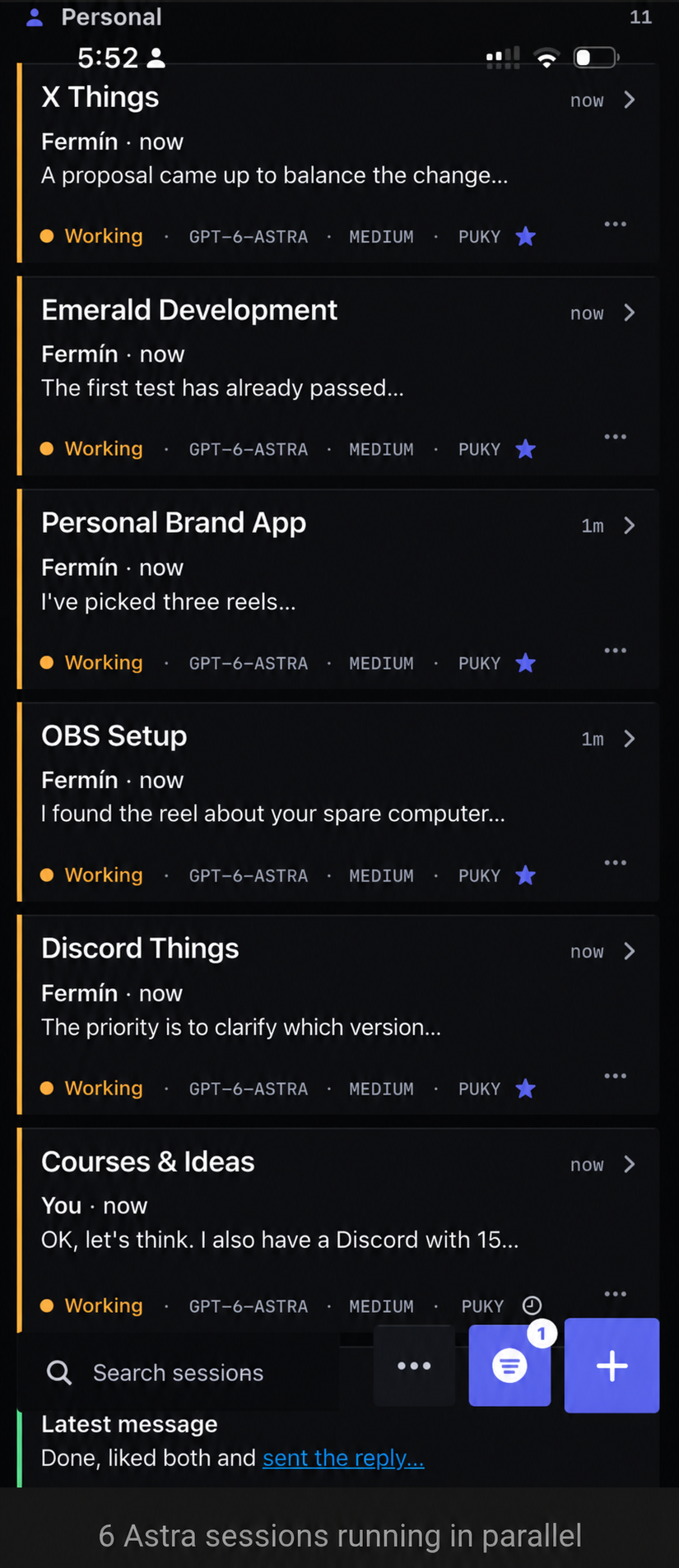
This is what it looks like on my phone: six sessions running in parallel, working on Emerald, content, my tools, and community projects. I move between them, check what happened, and send the next instruction. The work is running on the Mac at home.
A home server, with my own tools around it.
The Mac at home runs the relay and the services that keep the sessions connected. The clients on my phone and desktop let me follow the work and send instructions. Session events are stored so reconnecting doesn't mean starting over.
In the public Fermín Code architecture, Codex does the reasoning and uses the tools. The engine connects that work to the relay; the relay routes commands and updates to the clients. I built the layer around the agent because I wanted control over how I use it every day.
There is real infrastructure behind this: saved sessions, reconnecting clients, processes that stay running, and a computer that needs to stay online. It lives on my own hardware, with a setup I can change when I need something different.
I talked about the basic idea in this clip about giving your agents a spare computer. For me, that computer became a server at home.
I arrived here by needing it.
I recognized a similar approach in Theo Browne’s May 2026 walkthrough of his workflow: connecting to a remote Mac through T3 Code so the work can keep running independently of the laptop. Different tools, a familiar problem. For me, this had already become a daily habit earlier that year.
Seeing products like OpenAI Dots and Grok Bot makes the direction feel familiar: agents with a computer, tools, and work you can return to from another device.
My June article is an earlier public snapshot of the personal interface I was building. The home server setup has evolved since then. I wouldn't call these identical products. What I recognize is the need: give an agent somewhere to work, and make it easy to stay connected to that work.
I spend a lot of time using these tools, so I run into those needs pretty quickly. Building my own version is how I explore them. Sometimes a small annoyance turns into the next thing I end up using every day.
And then there's Fermín.
Fermín is my personal agent: tools, memory, and an app on my phone. Fermín Code is the interface for my coding sessions. They're separate projects, both shaped by the same habit of building things I need.
If you want the technical details, the Fermín Code source and setup guide are public. It takes configuration; it's the infrastructure and clients, not a hosted service.
For more of the thinking behind it, I wrote Agents are Loops in April 2025, and later shared how I use MCP for repetitive tasks. Same curiosity, more things built along the way.
← Back to all work